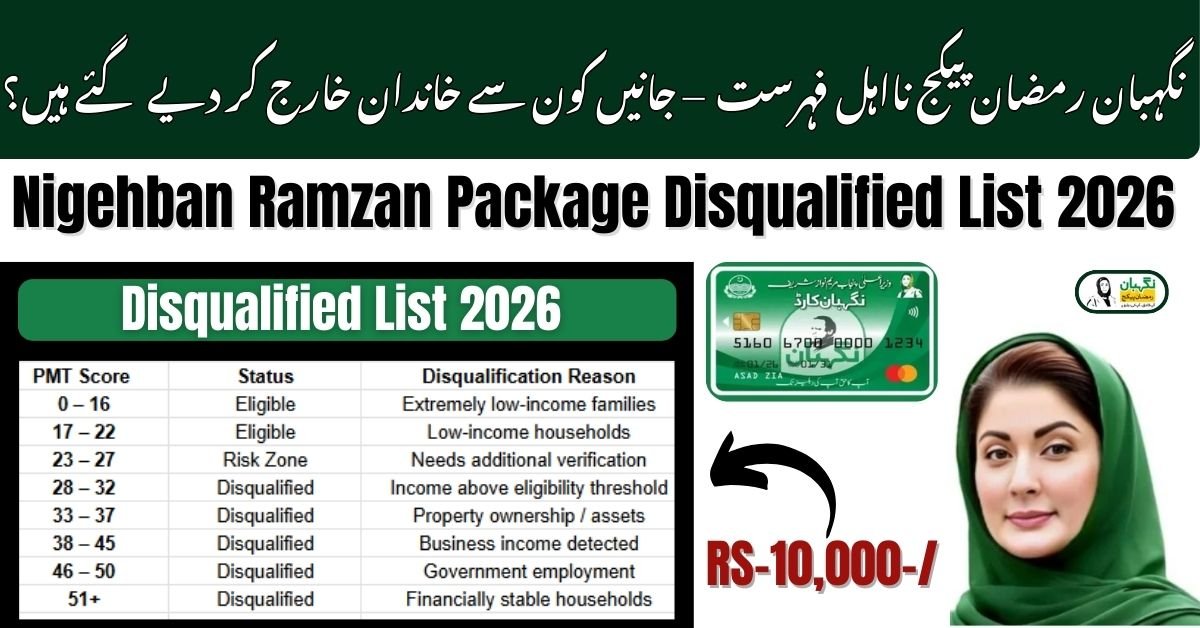
Nighaban Ramzan Package Disqualified List has been issued to inform applicants about families who were declared not eligible for the Ramzan relief program in 2026. Every year, thousands of households apply to receive free rations and essential food support during the holy month of Ramzan. The purpose of this initiative is to reduce the financial burden on low-income families so they can observe Ramzan with peace and dignity. However, to ensure that assistance reaches only deserving citizens, authorities carefully verify applications using socio-economic records, CNIC validation, and official welfare databases. This process removes duplicate entries, financially stable households, and applicants who do not meet poverty criteria. Many families feel confused or worried when they receive rejection messages, but understanding the reasons behind disqualification can help them correct their information and improve their chances in future programs.
Latest Update 2026
According to the latest update, authorities have completed large-scale verification through the Punjab Socio-Economic Registry and linked databases to ensure transparent distribution of relief.
Key Updates:
- Digital verification system introduced to detect duplicate beneficiaries
- Re-checking of household income records completed
- SMS 8070 service activated for eligibility and rejection status
- Only verified low-income families approved for Free Rashan 2026
- Data correction phase expected for applicants with incomplete records
- Stronger monitoring to prevent misuse of government assistance
Program Highlights 2026
| Feature | Details |
| Program Name | Nighaban Ramzan Package 2026 |
| Purpose | Provide ration support to deserving families |
| Verification System | Socio-Economic Data & CNIC Validation |
| Status Check Method | 8070 SMS Service |
| Assistance Type | Free Rashan / Subsidized Food Items |
| Target Group | Low-income households |
| Transparency | Digital eligibility screening |
Eligibility Criteria for the Ramzan Package 2026
Families must meet the following requirements to qualify:
- Monthly income below the defined poverty threshold
- Registered in the socio-economic database
- Possess a valid CNIC
- Not receiving duplicate benefits from other welfare programs
- Preference given to daily wage earners, widows, disabled persons, and laborer
- Household data must be correctly updated in survey records
Only applicants fulfilling these conditions are selected for assistance.
Benefits of the Nighaban Ramzan Package 2026
The program offers meaningful relief to struggling families during Ramzan. Key benefits include:
- Free ration packages containing essential food items such as flour, rice, sugar, and pulses
- Financial relief from increasing food prices during Ramzan
- Support for families with unstable or daily income
- Reduced stress on the household budget
- Equal assistance for deserving families in both rural and urban areas
- Transparent distribution through verified digital systems
- Improved food security during the holy month
These benefits allow families to focus on worship and daily needs without worrying about basic groceries.
Who Is Not Eligible for the Program?
Some applicants fall under the not-eligible category after verification. These families appear in the disqualified list due to the following reasons:
- Government employees receive regular salaries
- High-income earners or registered taxpayers
- Owners of businesses, commercial property, or large houses
- Individuals owning luxury vehicles
- Families already receiving multiple assistance programs
- Applicants who provided incorrect or incomplete information
- People whose socio-economic survey is missing or outdated
- Individuals not registered in official databases
These rules ensure fairness and prevent misuse of limited resources.
What Is the Disqualified List?
The Nighaban Disqualified List 2026 is a filtered record of applicants who applied but did not meet eligibility standards after verification. Authorities prepare this list to ensure that assistance reaches the most deserving households rather than being distributed without proper checks.
How Authorities Verify Applications
Many people wonder how the verification process works. Authorities review applications using:
- Household income and employment records
- Socio-economic survey data
- CNIC verification and family registration details
- Cross-checking with welfare databases
- Asset ownership, such as vehicles or property
This multi-step process ensures accuracy and prevents fraud.
Why Verification Is Important
Verification protects welfare programs from misuse and ensures transparency.
This process helps to:
- Ensure fair distribution of Ramzan relief
- Prevent duplicate or fraudulent applications
- Prioritize vulnerable households
- Improve the accuracy of welfare records
- Deliver assistance to deserving citizens only
Without verification, deserving families might be deprived of support.
Main Reasons for Disqualification in 2026
Many families are marked ineligible due to the following reasons:
- Income above the eligibility threshold
- Ownership of valuable assets or vehicles
- Incomplete or incorrect CNIC information
- Duplicate welfare benefits detected
- Survey data not updated or verified
Most of these issues can be corrected for future registrations.
8070 Rejection Reasons Explained
Common rejection responses include:
- Data not found in the registry
- Income above the eligibility limit
- Duplicate CNIC detected
- The survey is incomplete or outdated
- Information mismatch during verification
These messages indicate that applicants should update their records rather than submit repeated applications.
CNIC Ineligible Status Check – How to Verify
SMS Method
- Open your mobile message app
- Type your CNIC number without dashes
- Send it to 8070
- Receive your eligibility or rejection status instantly
This is the fastest and easiest way to confirm your status.
How to Check Payment (If Previously Approved)
Payment Check via SMS
- Send your CNIC number to 8070
- Receive confirmation about the ration or payment release
- Visit the Distribution Center
- You may also visit the nearest relief center with:
- Original CNIC
- Registered mobile number
Officials will guide you regarding your assistance record.
What To Do If You Are Disqualified
If your name appears in the disqualified list, do not panic. You can take corrective steps:
- Update your socio-economic survey information
- Ensure your CNIC details are correct
- Provide accurate income information in future registrations
- Avoid submitting multiple applications
- Wait for the next registration phase after data correction
Many applicants become eligible later after updating their records.
Common Mistakes Applicants Make
Many disqualifications happen due to simple errors:
- Entering an incorrect CNIC number
- Not completing the required survey
- Providing outdated household information
- Using unregistered mobile numbers
- Applying multiple times unnecessarily
- Ignoring official SMS notifications
Avoiding these mistakes can significantly improve approval chances.
Note: Our website provides information about government schemes and relief programs. As soon as any new update is announced, this article will be updated to keep you informed with the latest details.
Conclusion
The Nighaban Ramzan Package Disqualified List 2026 ensures that relief reaches only deserving families through a transparent and verified system. Although being declared not eligible can feel discouraging, it usually happens due to incomplete data, income-based screening, or record mismatches. By understanding eligibility rules and updating personal information, applicants can improve their chances of qualifying in future assistance programs.
FAQs – Nighaban Ramzan Package Disqualified List 2026
Q1: What is the Nighaban Ramzan Package Disqualified List 2026?
Answer:
The Disqualified List 2026 includes the names of applicants who are not eligible to receive assistance under the Nighaban Ramzan Package due to not meeting the program’s criteria.
Q2: Why are some families declared ineligible for the package?
Answer:
Families may be disqualified if their income level exceeds the defined limit, their data is incomplete or incorrect, they are already receiving aid from another government scheme, or their verification record does not match official databases.
Q3: How can I check if my name is on the disqualified list?
Answer:
You can check your status through the official verification method such as SMS CNIC check, online portal (if available), or by visiting the nearest facilitation center for confirmation.
Q4: Can disqualified applicants apply again?
Answer:
Yes, families can reapply or request a review if they believe they were wrongly disqualified. They must update their information and provide accurate documentation for re-verification.
Q5: What documents are required for re-verification?
Answer:
Applicants may need to provide a valid CNIC, proof of income (if required), family registration details, and any supporting documents requested by the authorities during the review process.
Q6: Does disqualification mean permanent rejection?
Answer:
No, disqualification is not always permanent. If your financial or household situation changes, or if there was an error in your data, you may become eligible after reassessment.
Q7: How long does the rechecking process take?
Answer:
The review process usually takes a few days to a few weeks, depending on the number of applications and the verification procedures.
Q8: Will I receive a notification if my status changes?
Answer:
Yes, applicants are typically informed through SMS or official communication once their eligibility status is updated.
Q9: What should I do if my CNIC data was entered incorrectly?
Answer:
You should immediately correct your information by resubmitting your CNIC through the official channel or visiting the nearest registration/help desk to avoid delays.
Q10: Is there any fee for checking eligibility or reapplying?
Answer:
No, the eligibility check and application process are completely free. Applicants should avoid agents or individuals asking for payment.